Barbara’s family · 11th great-grandfather
Tristram Coffin "Nantucket Owner"
Nantucket Owner
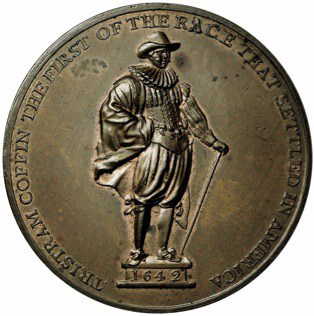
11 MAR 1609 – 20 OCT 1681Tristram Coffin, described in family notes as a founder and early proprietor of Nantucket, was born 11 March 1609 in Devon, England, and died in 1681 at Nantucket. He married Dionis Stevens about 1629. After emigrating with members of his family in 1642, he lived in several Massachusetts settlements, operated an ordinary and ferry near the Merrimack River, and became one of the purchasers and leading civil officers of Nantucket.
Tristram Coffin was born on 11 March 1609 in Devon, England. The supplied material gives conflicting birth places, naming both Brixton and Plymouth, Devonshire. He was said to have consistently spelled his surname Coffyn. About 1629, at Brixton, Devonshire, he married Dionis Stevens, identified as the daughter of Robert Stevens and Dionis Stevens.Family notes report that Coffin was named an executor and received a legacy in the will of his uncle John, dated 4 January 1628 and proved 3 April 1628; his sisters also received legacies. In 1642, he emigrated from England with Dionis, five children, his mother, and two sisters. The notes associate the family with Salisbury, Haverhill, and Newbury, Massachusetts, although the sequence of their residences is not wholly consistent. A family tradition states that the English Civil War forced his removal and that he was a Royalist. Another account says that the family arrived in late summer 1642 on the Hector, owned by Robert Clement of Plymouth; this voyage claim requires further documentation.
On 15 November 1642, Coffin and others received a deed from Passaquo and Saggahew for land at Petucket, later Haverhill, for £3 10s. The notes say that the grant covered several square miles and that the grantors marked the deed with representations of bows and arrows. Coffin was later associated with the Newbury side of the Merrimack River. In 1644 he was allowed to keep an ordinary, sell wine, and operate a ferry there; the order was renewed on 26 December 1647. George Carr held the ferry privilege on the Salisbury side.
In September 1653, Dionis Coffin was presented for selling beer at the ordinary for three pence a quart. Testimony showed that six bushels of malt had been used in the hogshead, and she was discharged. The family notes explain that the applicable requirement was four bushels of malt to the hogshead and that beer was to be sold for no more than two pence a quart.
On 2 July 1659, Coffin and eight others purchased Nantucket from Thomas Mayhew for £30 and two beaver hats, one for Mayhew and one for his wife. Mayhew retained a share in the island. On 10 October 1659, Coffin and his sons Peter, Tristram Jr., and James purchased Tuckernuck Island from Mayhew for £6. His house lot, sixty rods square at Cappamet Harbor, was laid out at a proprietors' meeting on 15 July 1661. Family notes state that he moved to Nantucket about 1660.
On 29 June 1671, Governor Francis Lovelace of New York appointed Coffin chief magistrate of Nantucket. On the same date, Coffin and others received a deed from Wanackmamack, described in the notes as head sachem of Nantucket, for lands and privileges for £40. Edmund Andros again appointed Coffin chief magistrate on 9 September 1677.
In 1677 Coffin conveyed a house and substantial real estate to his son Stephen, who agreed to assist his parents in their old age and sickness as he could. Coffin had previously deeded half of his estate to his daughter Mary and her husband, Nathaniel Starbuck; the deed was acknowledged in 1677. In the following year he gave his son John a new dwelling house and gave each grandchild ten acres on Tuckernuck Island for planting.
Coffin died at Nantucket in 1681. Administration of his estate was granted on 29 November 1681 to his sons John, James, and Stephen, who gave a bond of £100. An inventory was presented on 8 August 1682, when the court ordered that the estate be used by his widow during her lifetime. The supplied notes also describe him as a farmer, planter, businessman, ferryman, and possibly a blacksmith at Haverhill with his son John, but the latter occupation is not otherwise documented in the material provided.
Historical context
Coffin's life reflects the movement of English families into New England during the 1640s and the development of local enterprises such as ordinaries and ferries along the Merrimack River. His Nantucket purchases and public appointments place him among the island's early English proprietors and civil leaders. The land transactions described in the supplied notes involved Thomas Mayhew and Indigenous grantors named Passaquo, Saggahew, and Wanackmamack.
Sources & research
@S12@