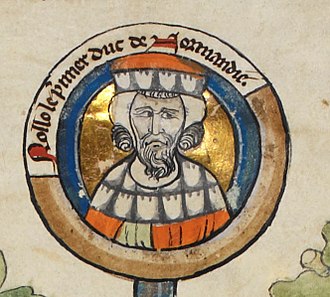
Barbara’s family · 24th great-grandfather
Rollo
first ruler of Normandy
ABT 860 – 17 DEC 932Rollo, also known in the supplied material as Rou, Hrólfr, and Rollon, was a Viking leader who became the first ruler of Normandy. He was born about 860, probably in Scandinavia, though the supplied accounts disagree on whether his origins were Danish or Norwegian. After Viking settlement along the lower Seine, he received recognition of lands centered on Rouen in return for allegiance, baptism, and defense against further raiders. He was succeeded by his son William Longsword.
Rollo was born about 860. His birthplace is not known with certainty, but the supplied material places it almost certainly in Scandinavia. Medieval accounts differ over whether he was Danish or Norwegian. The name Rollo is generally understood as a Latinized form of the Old Norse Hrólfr; Rou and Rollon are later forms used in Norman and French sources. Dudo of Saint-Quentin stated that Rollo took the baptismal name Robert.The earliest well-attested event associated with Rollo is the Viking siege of Paris in 885–886. The supplied material also reports that Dudo described Rollo's seizure of Rouen in 876; Flodoard recorded a campaign against Vikings in the region in which Rouen and other settlements were nearly destroyed, followed by a concession of certain coastal provinces to them.
According to Dudo, Rollo formed a friendship in England with a king called Alstem, identified in the supplied material as Guthrum, the Danish leader baptized Athelstan and recognized as king of the East Angles. Dudo also wrote that, after taking Bayeux by force, Rollo carried off Poppa or Poppa, daughter of Berenger, Count of Rennes. She was said to have become his wife and the mother of his son and heir, William Longsword. A daughter, Gerloc or Adele, was said to have married William III, Duke of Aquitaine.
In 911, following the siege of Chartres, Rollo and the Viking settlers on the lower Seine reached an agreement with Charles III, known as Charles the Simple, king of West Francia. Dudo placed the agreement at Saint-Clair-sur-Epte. In return for recognition of lands between the mouth of the Seine and the area now associated with Rouen, Rollo agreed to baptism, allegiance to the king, an end to raiding, and defense of the Seine estuary against Viking raiders. He was reportedly baptized Robert, after his godfather Robert I. Dudo also described a proposed marriage to Gisla, daughter of Charles, but the supplied material notes chronological uncertainty about whether she was legitimate or illegitimate and whether the marriage occurred.
A charter of Charles III dated 918 is the earliest surviving record that names Rollo directly. It refers to an earlier grant to “Rollo and his associates,” described as the Normans of the Seine, for the protection of the kingdom. Rollo made Rouen his principal center and divided lands between the Epte and Risle among his chieftains. His authority was subsequently extended westward in arrangements involving the Bessin and Maine, although the supplied material notes uncertainty about the exact nature of those concessions.
Rollo remained ruler in Normandy until at least 928. The supplied life dates give his death as 17 December 932, while the narrative evidence places his death sometime after Flodoard's final mention of him in 928 and before a land grant to William in 933. William Longsword succeeded him.
Rollo's followers and their descendants intermingled with the Frankish and Gallo-Roman population of the lands they settled and became known as Normans. Rollo's descendants later ruled Normandy, Norman England, parts of Ireland, the Kingdom of Sicily, and the Principality of Antioch. The supplied material identifies Rollo as an ancestor of William the Conqueror and states that Elizabeth II and the British royal family were direct descendants of Rollo.
Historical context
Rollo lived during a period of Viking raids, settlement, and political rivalry in West Francia. Viking groups had established a foothold in the lower Seine valley, while Frankish rulers sought both to defend their territories and to incorporate those settlers into a stable political arrangement. The agreement associated with Rollo helped create the territorial foundation of Normandy. Over subsequent generations, the Norman principality became a major power in western Europe.
Sources & research
Original family tree maker notes, including bracketed citations [4] through [47]; no bibliographic details were supplied for those numbered citations.
Dudo of Saint-Quentin, Historia Normannorum, also called Libri III de moribus et actis primorum Normanniae ducum.
Flodoard, contemporary chronicle.
Charles III charter of 918.
Gesta Danorum.
Roman de Rou, by Wace.
William of Jumièges.
Orderic Vitalis.
Goffredo Malaterra, or Geoffrey Malaterra.
William of Malmesbury.
Benoît, probably Benoît de Sainte-More, Chronique des ducs de Normandie.
Heimskringla.
Orkneyinga Saga.
Richer.
An Banshenchas.
Laxdœla saga.
2011 genetic investigation announcement concerning the remains attributed to Richard the Fearless and Richard the Good.
Report dated 29 February 2016 concerning the opening of Richard the Good's tomb.