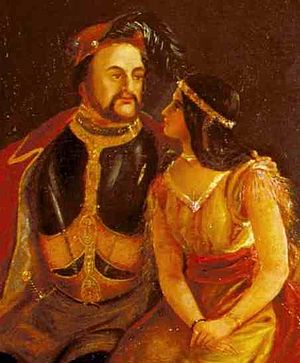
· 12th Great Grandmother
Pocahontas
17 Sep 1595 - May 1617Pocahontas, the user's 12th great-grandmother, was born 17 September 1595 and died in May 1617. Known in colonial accounts by the childhood nickname Pocahontas, she was also reported to have used the name Matoax and, after baptism, Rebecca. She married colonist John Rolfe on 5 April 1614, and they had a son, Thomas, born in January 1615.
Pocahontas was born on 17 September 1595 and died in May 1617. She is identified in this family tree as the user's 12th great-grandmother.According to colonist William Strachey, “Pocahontas” was a childhood nickname meaning “little wanton,” although it has also been interpreted as “playful one.” Strachey described her as a child visiting the fort at Jamestown and playing with the young boys there. Historian William Stith later claimed that her original name was Matoax and that it was concealed from the English out of fear that knowledge of her true name might be used to harm her. Anthropologist Helen C. Rountree wrote that she revealed this name to colonists only after receiving the Christian baptismal name Rebecca. These statements reflect colonial and later historical accounts and should be understood with their stated attributions.
While staying at Henricus, Pocahontas met John Rolfe. Rolfe had previously lost his English-born wife, Sarah Hacker, and their child, Bermuda, following the wreck of the Sea Venture on the Summer Isles, also known as Bermuda. He established the Virginia plantation Varina Farms, where he cultivated a new strain of tobacco.
Pocahontas had accepted Christianity and taken the baptismal name Rebecca before her marriage to Rolfe. In a letter seeking the governor's permission to marry her, Rolfe wrote that his motives were “not by the unbridled desire of carnal affection,” but “for the good of this plantation, for the honor of our country, for the Glory of God, for my own salvation,” and for Pocahontas, “to whom my hearty and best thoughts are.”
Pocahontas and John Rolfe were married on 5 April 1614 by chaplain Richard Buck, probably at Jamestown. They lived for two years at Varina Farms, across the James River from Henricus. Their son, Thomas, was born in January 1615.
Their marriage was said to have created a period of peace between the Jamestown colonists and Powhatan's tribes. This period was later called the “Peace of Pocahontas” and was reported to have lasted eight years. In 1615, Ralph Hamor wrote that, since the wedding, the colonists had enjoyed friendly commerce and trade with Powhatan and his subjects. The marriage was controversial at the British court because Rolfe, described as a commoner, had married a princess.
Historical context
Pocahontas lived during the early years of the Jamestown colony in Virginia. Her marriage to John Rolfe was associated in the supplied account with improved trade and relations between Jamestown colonists and Powhatan's tribes. Rolfe's tobacco cultivation at Varina Farms also formed part of the colonial setting in which they lived.
Sources & research
William Strachey, colonial account of Pocahontas's nickname and childhood activities at Jamestown [14], [16].
Unnamed interpretation of the nickname Pocahontas as “playful one” [15].
William Stith, historical claim concerning the name Matoax and its concealment [17].
Helen C. Rountree, account of the name Matoax and the baptismal name Rebecca [18].
John Rolfe, letter to the governor requesting permission to marry Pocahontas [43].
Marriage and birth information as cited in the supplied notes [44].
Account of the “Peace of Pocahontas” [45].
Ralph Hamor, 1615 statement concerning friendly commerce and trade after the marriage [46].
Account of controversy at the British court concerning the marriage [47], [48].