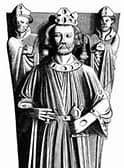
· 21st Great Grandfather
John I "King of England"
King of England
24 Dec 1166 - 19 Oct 1216John I, known as King John of England, reigned from 1199 until his death in 1216. The youngest of King Henry II and Duchess Eleanor of Aquitaine’s four surviving sons, he lost Normandy and most other French lands, faced a dispute with Pope Innocent III, and confronted a baronial revolt that led to the sealing of Magna Carta in 1215.
John I was born on 24 December 1166, the youngest of the four surviving sons of King Henry II of England and Duchess Eleanor of Aquitaine. He was nicknamed “John Lackland” because he was not expected to inherit significant lands. After the failed revolt of 1173–1174 by his brothers Henry the Young King, Richard, and Geoffrey against their father, John became Henry II’s favourite child.In 1177, John was appointed Lord of Ireland and received lands in England and on the Continent. During the reign of his brother King Richard, while Richard was taking part in the Third Crusade, John unsuccessfully attempted a rebellion against Richard’s royal administrators. After Richard died in 1199, John was proclaimed king.
John reached an agreement with King Philip II of France at the Treaty of Le Goulet in 1200, under which Philip recognized John’s possession of the continental Angevin lands. War resumed in 1202. John won early victories, but shortages of military resources and his treatment of Norman, Breton, and Anjou nobles contributed to the collapse of his empire in northern France in 1204. He lost the Duchy of Normandy and most of his other French lands, a development associated with the collapse of the Angevin Empire and the later growth of Capetian power in France.
For much of the following decade, John attempted to recover these lands. He raised substantial revenues, reformed his armed forces, and rebuilt continental alliances. His judicial reforms had a lasting effect on the English common-law system and also provided additional revenue. A dispute with Pope Innocent III resulted in John’s excommunication in 1209; he settled the dispute in 1213.
John’s effort to defeat Philip II in 1214 failed after the French victory over John’s allies at the Battle of Bouvines. On his return to England, he faced rebellion from many barons, who were dissatisfied with his fiscal policies and his treatment of some of England’s most powerful nobles. John and the barons agreed to the Magna Carta peace treaty in 1215, but neither side complied with its terms, and civil war followed. The barons received aid from Louis VIII of France, and the conflict soon reached a stalemate.
John died on 19 October 1216, reportedly of dysentery contracted while campaigning in eastern England. Supporters of his son, Henry III, defeated Louis and the rebel barons in the following year.
Contemporary chroniclers were mostly critical of John’s performance as king. Later historians have debated and periodically revised assessments of his reign. Jim Bradbury summarized a view that John was a hard-working administrator, able man, and able general, while Ralph Turner described him as having distasteful and potentially dangerous personality traits, including pettiness, spitefulness, and cruelty. John has remained a recurring figure in Western popular culture, especially as a villain in works connected with the Robin Hood legends.
Historical context
John’s reign took place during the decline of the Angevin Empire’s continental possessions. His loss of Normandy and other French lands strengthened the position of the French Capetian dynasty during the thirteenth century. The baronial revolt near the end of his reign led to the sealing of Magna Carta in 1215, described in the supplied notes as an early step in the evolution of the constitution of the United Kingdom.
Sources & research
[1] Citation marker attached in the original family tree notes to the statement that John was nicknamed John Lackland because he was not expected to inherit significant lands. Bibliographic details were not supplied.
[2] Citation marker attached in the original family tree notes to the quoted assessment attributed to historian Jim Bradbury. Bibliographic details were not supplied.
[3] Citation marker attached in the original family tree notes to the assessment attributed to historian Ralph Turner. Bibliographic details were not supplied.