Barbara’s family · 9th great-grandfather
James Sandys "Capt.-Mariner"
Capt.-Mariner
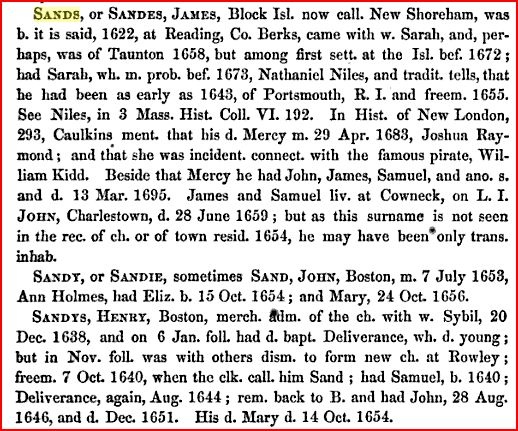
ABT 1622 – 13 MAR 1695James Sandys, later called James Sands, was an English-born carpenter, mariner, and early settler associated with Portsmouth, Rhode Island, and Block Island (later New Shoreham). Family-tree notes describe him as one of sixteen purchasers of Block Island and as a local officeholder and militia leader. He died on 13 March 1695, reportedly aged 73.
James Sandys, later known as James Sands, was born about 1622 in Reading, Berkshire, England. Family-tree notes state that he immigrated to Plymouth, Massachusetts, in 1638 and adopted the surname Sands after coming to New England. He was described as a carpenter and as “Capt.-Mariner.”According to the notes, he was at East Chester, Westchester County, New York, in 1642, where he was engaged in building a house for Ann Marbury Hutchinson, who was reputed to have been his mother-in-law. The stated relationship to Hutchinson is a tradition or report rather than a documented conclusion in the supplied material. The notes further place him in Boston and then back at Plymouth in 1647.
James married Sarah, daughter of John and Katherine Walker, at Portsmouth, Rhode Island, in 1645. He received land grants at Portsmouth on 5 October 1643 and 29 August 1644, and he was made a freeman there in 1655. In 1657 he served as Portsmouth’s commissioner at the Rhode Island General Court.
In 1660, James was one of sixteen purchasers of Block Island, then called Manisses by its Indigenous inhabitants. The notes state that the sixteen families sailed from Taunton, Massachusetts, to the island, where the land was divided into sixteen shares. James received one share. He was active in the settlement’s civic affairs, serving as constable in March 1663–64, deputy from Block Island to the General Assembly in 1665, tax rater in October 1670 and September 1671, and assistant warden in 1676. He was among those who petitioned for a charter of incorporation; the settlement received its charter in 1672 under the name New Shoreham.
The family-tree notes state that, during King Philip’s War of 1675–1676, James commanded a militia company. His Block Island house was reportedly used as a fort and garrison and served as company headquarters. The same notes also refer to him as commander of the New Shoreham Company before his coming to Block Island, a statement whose chronology is unclear from the supplied material.
On 15 November 1690, James Sands conveyed land to his son John Sands by a deed recorded in the Hempstead New Book of Record, pages 345–61, by Thomas Gildersleeve, clerk. The land was described in the notes as that on which James had first settled after coming to Block Island.
James Sands died at New Shoreham, Rhode Island, on 13 March 1695. He was reportedly buried in the public graveyard on Block Island. The inscription transcribed in the notes identifies him as “Mr. James Sands, Senior,” aged 73, and gives his death as 13 March 1695. His widow, Sarah, was said to have survived until 1709. A memoir by his grandson Niles was said to recount family experiences involving Indigenous people and French privateers on Block Island, and the notes state that French depredations contributed to James’s sons later moving to Cowneck.
Historical context
James Sands’s life in New England unfolded during English colonial expansion into lands already inhabited and governed by Indigenous peoples. The supplied notes identify Block Island as Manisses, its Indigenous name, and state that James and fifteen others purchased the island in 1660. During King Philip’s War, a conflict of 1675–1676 involving several New England colonies and Indigenous nations, the notes report that Sands’s house on Block Island was fortified and used by a militia company.
Sources & research
Current source: @S12@
Charles H. Sandy, Dawn to Twilight in American Colonization: The Story of the Sandys and Others who Settled Virginia and Other Colonies (New York: Exposition Press), p. 178.
http//www.piaf.com/genealogy/js1622.html
Hempstead New Book of Record, pp. 345–61, deed from James Sands to John Sands, dated 15 November 1690; Thomas Gildersleeve, clerk.