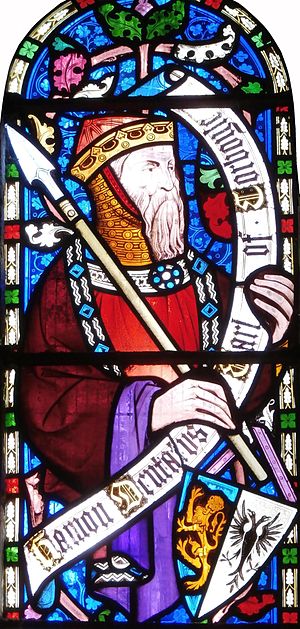
Barbara’s family · 20th great-grandfather
Hamon "Dentatus"
Norman Baron
ABT 1002 – 10 AUG 1047Hamon “Dentatus,” also recorded as Hamon Dens and under other variant spellings, was a Norman baron who died on 10 August 1047 at the Battle of Val-ès-Dunes. He was among the Norman barons who rebelled against William II, Duke of Normandy. He is identified in this family tree as the 20th great-grandfather.
Hamon “Dentatus” was born about 1002. Little is known of his life. His epithet appears in forms including “Dentatus,” “Dens,” and the French “aux-Dents.” It was probably attributed to a tradition that he was born with teeth.Later accounts associate Hamon with Thorigny, Mezi, and Croillie, places said to correspond roughly with present-day Torigni-sur-Vire, Grandcamp-Maisy, and Creully. Wace described him as lord of these places. A later history of the barons of Creully claimed that “Haimon-Az-Dentz” was the first baron of Creully, but that claim rested on an earlier text said to have been destroyed during the French Revolution.
In 1047, Hamon joined other Norman barons in rebellion against William II, Duke of Normandy, at the Battle of Val-ès-Dunes. William of Poitiers referred to him in Latin as “Haimonem agnomine Dentatum,” while later writers remembered him as one of the rebels. Benoît de Sainte-Maure characterized him harshly as an “antichrist” for rebellion against his lord, the duke.
Accounts differ regarding Hamon’s part in the battle. One states that he unhorsed King Henry I of France, who had supported the duke, before French forces killed Hamon. Another account attributes the unhorsing of the king not to Hamon but to his uncle, Guillesen. Wace and Benoît both reported that Haimo invoked Saint Amand as his battle cry; Saint Amand was the patron saint of Hamon’s fiefdom of Thorigny, sometimes called Saint Amand of Thorigny.
Hamon died on 10 August 1047. William of Malmesbury wrote that King Henry ordered him an honorable burial in admiration of his valor. Wace stated that Hamon was buried near the church of Esquay-Notre-Dame.
Historical context
Hamon lived during the early rule of William II, Duke of Normandy, whose reign is given as 1035–1087. The Battle of Val-ès-Dunes in 1047 was fought during a rebellion by Norman barons against the duke. King Henry I of France, whose reign is given as 1027–1060, supported William in the conflict.
Sources & research
Original family tree maker notes cite references [2] through [14], but do not provide full bibliographic details.
William of Poitiers, c. 1020–1090: early account of the Battle of Val-ès-Dunes; renders the name in Latin as “Haimonem agnomine Dentatum.” [6]
Orderic Vitalis, 1075–c. 1142: states that William the Conqueror recalled “Haymon-aux-Dents” among the rebels.
Wace: account of the battle written about 1174; calls him “Hamon-As-Dens,” lord of “Thorignie,” “Mezi,” and “Croillie,” and reports his burial near the church of Esquay-Notre-Dame. [7] [13]
Benoît de Sainte-Maure, died 1173: calls him “Hamun,” characterizes him as an “antichrist” for rebellion against the duke, and reports Saint Amand as his battle cry. [8]
Pezet, history of the barons of Creully: claims that “Haimon-Az-Dentz” was the first baron of Creully and discusses a purported 912 foundation record later destroyed in the French Revolution. [10] [11]
William of Malmesbury, c. 1095–1143: writes that King Henry ordered Hamon an honorable burial in admiration of his valor. [14]
Unidentified source: attributes the unhorsing of King Henry I to Hamon’s uncle, Guillesen, rather than Hamon. [13]
Unidentified cited material: Hamon’s death in rebellion at Val-ès-Dunes is supported in the original notes by [2] and [3]; the explanation of the epithet is cited as [4]; and the statement that little is known of his life is cited as [5].
Unidentified cited material: the account that Hamon unhorsed King Henry I and was then killed by French forces is cited as [12].
Unidentified cited material: Saint Amand as patron saint of Thorigny is cited as [9].