·
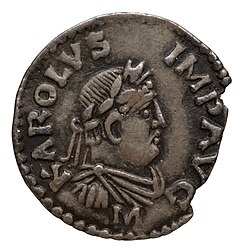
Charlemagne Charles the Great
King of the Franks
02 Apr 747 AD - 28 Jan 813 ADCharlemagne, also known as Charles the Great, was King of the Franks from 768, King of the Lombards from 774, and emperor from 800 until his death. A member of the Carolingian dynasty and son of Pepin the Short and Bertrada of Laon, he expanded Frankish rule across much of Western and Central Europe, promoted church and governmental reforms, and made Aachen the principal centre of his rule. His reign is closely associated with the Carolingian Renaissance and left a long political, religious, and cultural legacy.
Charlemagne, or Charles the Great, was the eldest son of Pepin the Short and Bertrada of Laon. His birth year is uncertain. The supplied material identifies 2 April as his birth date and says that most modern scholars accept April 748, while an older tradition gives 742. His birthplace is unknown; Vaires-sur-Marne, Quierzy, and Herstal have been suggested. He was named after his grandfather, Charles Martel.Charlemagne grew up in the Frankish Carolingian world, where Germanic and Romance speech were both used. He probably spoke Germanic and Romance dialects and knew Latin; according to Einhard, he could understand and perhaps speak some Greek. The extent of his formal education and literacy remains debated, though he was trained in military matters and later strongly encouraged the study of the liberal arts, religious learning, and literacy.
Pepin the Short died on 24 September 768. Charlemagne and his younger brother, Carloman I, succeeded him as joint rulers of the Franks and were separately crowned on 9 October 768, Charlemagne at Noyon and Carloman at Soissons. Their partnership was strained, particularly during the campaign in Aquitaine. After Carloman died suddenly on 4 December 771, Charlemagne became sole king of the Franks. He secured control of his brother’s territories, while Carloman’s widow Gerberga and her children fled to the Lombard court.
Charlemagne had earlier been associated with the Frankish noblewoman Himiltrude, with whom he had a son, Pepin, born in 769. He later entered a marriage alliance with a daughter of the Lombard king Desiderius, traditionally called Desiderata, although the supplied material notes that she may have been named Gerperga. He ended that marriage and married Hildegard, daughter of Count Gerold. Their children included Charles the Younger, Rotrude, Bertha, Louis, and Pepin, who had first been named Carloman. Hildegard died on 30 April 783 following complications of childbirth. Charlemagne subsequently married Fastrada, who died after falling ill in 794, and then married the Alamannian noblewoman Luitgard.
As sole king, Charlemagne began a long series of campaigns. His wars against the Saxons lasted for more than three decades. Early in this conflict, he destroyed the pagan Irminsul at Eresburg. Saxon resistance continued under the leader Widukind. In 782, after a Frankish defeat and renewed rebellion, the annals record that Charlemagne had 4,500 Saxon prisoners beheaded at Verden. The supplied material notes that the reported number may be exaggerated, but regards the underlying event as established. His subsequent laws for Saxony included severe penalties for pagan practices, and his forces repeatedly devastated Saxon territory, removed many Saxons to Francia, and installed Frankish settlers. Widukind submitted to baptism in 785, with Charlemagne serving as his godfather, although conflict in Saxony continued into the 790s and concluded only after further campaigns.
In 773, Charlemagne crossed the Alps to intervene against Desiderius, King of the Lombards, in response to appeals from Pope Adrian I and to the presence of Carloman’s family in Lombardy. He besieged Pavia, captured Verona, and became King of the Lombards after Pavia surrendered in June 774. Desiderius and his family were confined in a monastery. Charlemagne’s acquisition of Lombardy strengthened his relationship with the papacy and made him ruler of both the Frankish and Lombard kingdoms.
His reign also brought expansion and conflict in other regions. He campaigned in northern Spain after receiving approaches from opponents of the ruler of Córdoba, but the Frankish withdrawal in 778 followed an ambush by Basque forces at the Battle of Roncevaux Pass. He extended Frankish authority over Bavaria after deposing Duke Tassilo in 788, and campaigns against the Avars contributed to the collapse of their kingdom and the eastward expansion of Frankish rule. He asserted influence in Benevento, dealt with Byzantine interests in Italy, made peace with King Offa of Mercia in 796, maintained ties with Anglo-Saxon rulers, and formed an alliance with Alfonso II of Asturias.
Charlemagne created royal roles for his sons. In 781, Pope Adrian baptized his son Carloman, renamed him Pepin, and anointed him king of the Lombards; Louis was anointed king of Aquitaine. Charles the Younger held authority in Neustria and was later made king. Pepin, Charlemagne’s eldest son by Himiltrude, later known as Pepin the Hunchback, was excluded from the succession and was sent to a monastery after a conspiracy against Charlemagne was uncovered in 792.
On Christmas Day 800, Pope Leo III crowned Charlemagne emperor in St. Peter’s Basilica in Rome. The meaning, planning, and contemporary understanding of the coronation remain debated in the supplied material. The event nevertheless marked the height of his authority and made him the first reigning emperor in the West since the deposition of Romulus Augustulus in 476. Charlemagne thereafter used an imperial title while continuing to identify himself as king of the Franks and Lombards. His position led to prolonged questions about relations with the Eastern Roman, or Byzantine, Empire. In 811, an agreement with Emperor Michael I brought Byzantine recognition of Charlemagne as emperor.
After 800, Charlemagne increasingly governed from Aachen. He issued legislation concerning royal officials, justice, loyalty, and legal codes, including the Capitulare missorum generale of 802. He used pairs of royal representatives, known as missi dominici, to administer justice and oversee local government. He revised Lombard and Frankish law, ruled through his sons in their kingdoms while retaining ultimate authority, and planned the division of his territories in the Divisio Regnorum of 806.
Charlemagne also pursued diplomacy beyond his immediate frontiers. He exchanged envoys with Harun al-Rashid, the Abbasid caliph, during the 790s. Harun sent him gifts, including an elephant named Abul-Abbas, which reached Aachen in 802. Charlemagne also took part in disputes over doctrine and worship, supported the use of the filioque in Western Christian practice, and promoted standardization of church administration, monastic life, education, and liturgy.
In his later years, Charlemagne faced conflict with the Danes under King Gudfred. After campaigning in Saxony in 804, he settled Saxons east of the Elbe and gave lands there to his Obotrite allies. Danish pressure on the northern frontier continued until Gudfred’s death in 810. Peace was concluded with Gudfred’s successor Hemming in 811.
Charlemagne suffered several family losses in 810 and 811, including his sister Gisela, his daughter Rotrude, and his sons Pepin the Hunchback, Pepin of Italy, and Charles the Younger. He named Bernard, son of Pepin of Italy, ruler of Italy, and made his remaining surviving son, Louis, heir to the rest of the empire. On 11 September 813, at Aachen, Charlemagne crowned Louis co-emperor and Bernard king.
Charlemagne became ill in the autumn of 813 and died at Aachen on 28 January 814. He was buried that day in the chapel of his palace at Aachen, now part of Aachen Cathedral. Louis arrived at Aachen 30 days later and assumed control of the palace and empire. Charlemagne’s remains were later reinterred by Frederick Barbarossa in 1165 and by Frederick II in 1215.
Charlemagne’s empire did not remain united long after his death. Following later conflicts among the sons of Louis, it was divided by the Treaty of Verdun in 843. Yet Charlemagne’s governmental structures, educational policies, support for Latin learning, and efforts to shape a shared Western Christian identity had enduring influence. His reign is associated with the Carolingian Renaissance, a revival of learning, manuscript production, and intellectual activity. He has often been called the Father of Europe, while modern accounts also recognize the violence of his conquests and the complexity of his legacy.
Historical context
Charlemagne ruled during a period when the Carolingian family had replaced the Merovingian dynasty as the leading power in Francia. The Frankish kingdom had grown from territories in Gaul and was shaped by traditions of divided inheritance, regional rule, and close relationships between kings, aristocrats, and church leaders.
His reign connected northern and central Europe, Italy, Iberia, the Byzantine world, the British Isles, Scandinavia, and the Abbasid caliphate. His campaigns expanded Frankish power, but also involved forced conversion, population transfers, hostage taking, and severe violence, particularly in Saxony.
The cultural activity of the period drew on scholars from Ireland, Anglo-Saxon England, Italy, Spain, and Francia. Court and church reforms encouraged schools, manuscript copying, standardized Latin, legal writing, and more uniform religious practice. These developments helped preserve and transmit texts and learning through the Middle Ages.
Sources & research
Original family tree maker notes supplied for this biography, including numbered citations [1] through [344]. No bibliography or full publication details corresponding to those numbered citations were supplied.
Named works and records identified within the supplied notes include: Royal Frankish Annals; Annales Petaviani; Gesta Episcoporum Mettensium by Paul the Deacon; Vita Karoli Magni by Einhard; Capitulatio de partibus Saxoniae; Libri Carolini; Capitulare missorum generale; Divisio Regnorum; Basel roll; Thegan’s biography of Louis; Admonitio generalis; Epistola de litteris colendis; Visio Karoli Magni; Gesta Karoli Magni by Notker; Song of Roland; Historia Caroli Magni, also known as the Pseudo-Turpin Chronicle; and the Rule of St. Benedict.