Barbara’s family · 11th great-grandfather
Captain Edmund Greenleaf
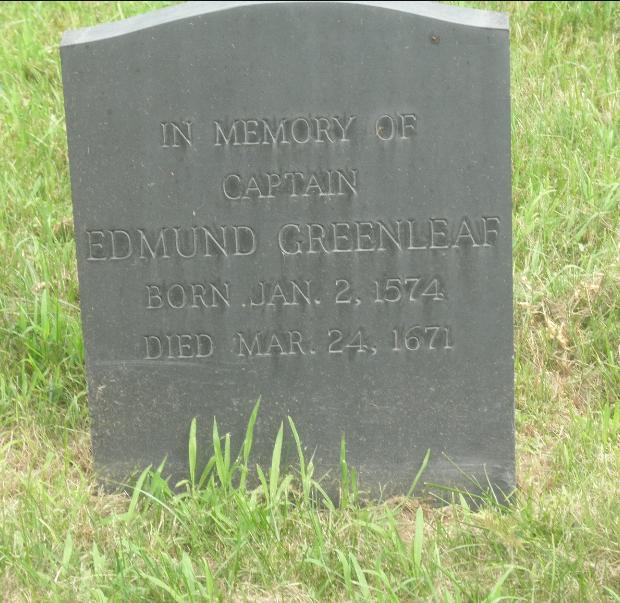
2 JAN 1574 – 21 MAR 1671Captain Edmund Greenleaf was an early Newbury settler, a silk dyer and tavernkeeper who later moved to Boston. The supplied material associates him with English origins, arrival in Massachusetts about 1634 or 1635, public and military service in Newbury, and a will dated 22 December 1668.
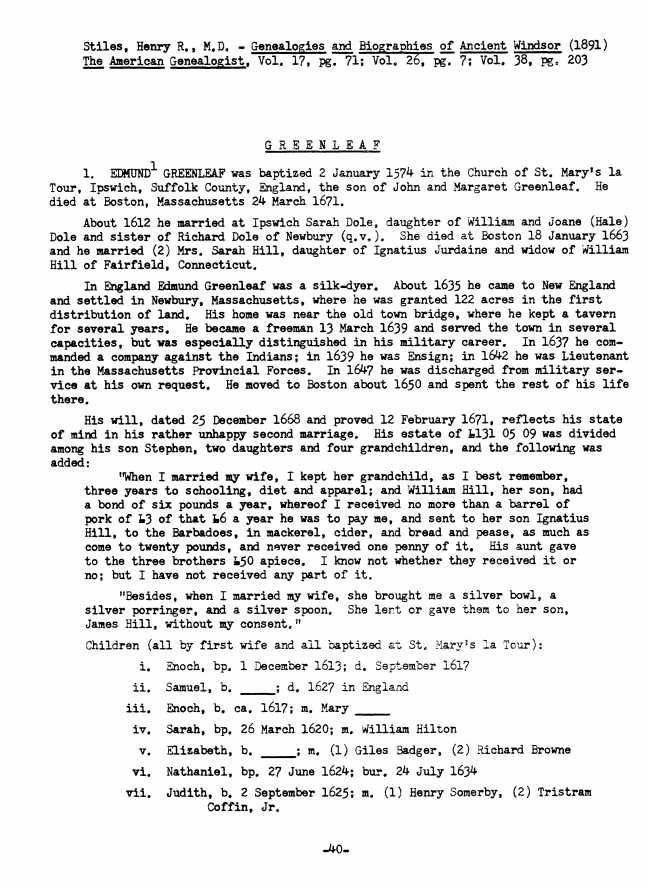
Edmund Greenleaf’s birth is reported as 2 January 1574, when an Edmund Greenleaf, son of John and Margaret, was baptized at St. Mary’s la Tour, Ipswich, Suffolk, England. The supplied notes caution that this baptism may have been too early for the Edmund Greenleaf who emigrated to Massachusetts and report that other sources suggest a birth about 1590. Family tradition further holds that the family may have had Huguenot origins, with the name Greenleaf translated from the French “Feuillevert”; this has not been established in the material provided.Greenleaf was a silk dyer by trade. He reportedly came from England to Massachusetts about 1635, although the notes also place his voyage aboard the Mary and John in 1634. He was among the early principal settlers of Newbury, then associated with the Agawan Plantation near Ipswich. The notes state that nine of his children were born in England and that their baptisms and deaths appear in the parish records of St. Mary’s la Tour.
In Newbury, Greenleaf lived near the old town bridge and for some years kept a tavern. He was admitted a freeman on 13 March 1638/9 and, on 22 May 1639, was permitted to keep a house of entertainment. He received a grant of 122 acres. The records and notes refer to him as Captain and later as Ensign.
His name appears in several Massachusetts Bay records. On 1 June 1642 he was on a Newbury commission. In September 1642 he was ordered to send home an Indian woman and served on a committee charged with certain council orders. He requested discharge from military service on 11 November 1647, and on 2 May 1649 he participated in an appraisal of real estate.
About 1650, Greenleaf reportedly moved to Boston with his wife Sarah. His dyehouse was located by the spring on 30 May 1655. After the death of his wife Sarah, the notes state that he married Sarah Hill, who was described as a widow with children from a previous marriage. His surviving probate papers include a statement concerning financial matters involving members of the Hill family and certain silver household articles.
Greenleaf made his will on 22 December 1668, naming his son Stephen Greenleaf, his daughters Elizabeth Browne and Judith Coffin, and several grandchildren. He appointed Stephen Greenleaf and Tristram Coffin as executors and asked his cousin, Thomas Moon, mariner, to oversee its performance. The estate inventory totaled £131-5-9. He died in Boston in early 1671; the supplied material gives conflicting dates of 21 March and 24 March 1670/71. He was reportedly buried in the Burying Ground of the First Settlers at Newbury, Essex County, Massachusetts.
Historical context
In early Massachusetts Bay, admission as a freeman carried the right to vote. The supplied notes explain that church membership was required for that status under laws adopted by the colony’s assistants or magistrates. Greenleaf’s permission to keep a house of entertainment reflects the regulation of tavernkeeping in the colony.
Sources & research
St. Mary’s la Tour parish records, Ipswich, County Suffolk, England: baptismal record cited for “Edmund Greenleaf, son of John and Margaret,” 2 January 1574; the supplied notes also refer to baptismal and death records for nine children.
Massachusetts Bay Records, Volume I, page 258; Volume II, pages 16, 23, 30, 215, and 276: entries dated 1 June 1642, 8 September 1642, 27 September 1642, 11 November 1647, and 2 May 1649.
New England Historical and Genealogical Register, Volume VI, page 102: cited for the move of Edmund Greenleaf and his wife Sarah to Boston about 1650.
Boston Probate Records, volume for 1669 to 1674, page 112: will of Edmund Greenleaf and related probate material; the supplied notes give a probate date of 12 February 1671 and also state “probated 12 (2) 1671.”