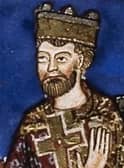
Barbara’s family
. Henry II King of England
5 MAR 1133 – 6 JUL 1189 · 22nd great-grandfatherHenry II King of England (5 March 1133 – 6 July 1189) was King of England from 1154 until his death and the first king of the House of Plantagenet. In the supplied family relationship path, he is identified as the 22nd great-grandfather of James Dempsey Waters through Barbara’s family.
Henry acquired major continental lands before becoming king. He became Duke of Normandy in 1150, Count of Anjou and Maine on the death of his father, Count Geoffrey V, in 1151, and Duke of Aquitaine through his 1152 marriage to Eleanor of Aquitaine, whose marriage to Louis VII of France had recently been annulled. He became Count of Nantes by treaty in 1158.
Following Henry’s military expedition to England in 1153, Stephen agreed to a peace treaty. When Stephen died the following year, Henry inherited the kingdom and began his reign as King of England in 1154. During the early years of his reign, he restored royal administration in England, re-established authority in Wales, and gained full control over Anjou, Maine, and Touraine. Before reaching age 40, he controlled England, large parts of Wales, the eastern half of Ireland, and the western half of France, an area later called the Angevin Empire. At various times he also partially controlled Scotland and the Duchy of Brittany.
Henry sought to reform the relationship between the Crown and the Church, bringing him into prolonged conflict with his former friend Thomas Becket, Archbishop of Canterbury. The dispute lasted through much of the 1160s and ended with Becket’s murder in 1170. Henry also remained in long conflict with Louis VII of France. He expanded his lands at Louis’s expense, taking Brittany and extending influence east into central France and south toward Toulouse, but peace conferences and treaties produced no lasting settlement.
Henry and Eleanor had eight children: three daughters and five sons. Three of their sons would become kings. Their son Henry, known as the Young King, was named his father’s co-ruler rather than an independent ruler. Disputes over the future inheritance of Henry’s lands grew as the children reached adulthood. In 1173, the Young King rebelled against his father, joined by his brothers Richard and Geoffrey and by their mother, Eleanor. France, Scotland, Brittany, Flanders, and Boulogne supported the rebels. Henry defeated the Great Revolt through military action and the work of local commanders.
The Young King and Geoffrey rebelled again in 1183; the Young King died during that rebellion. The Norman invasion of Ireland created lands for Henry’s youngest son, John, later King John I of England, but Henry continued to struggle to satisfy his sons’ demands for land and authority. By 1189, both the Young King and Geoffrey had died. Philip II of France encouraged Richard’s fears that Henry would make John king, contributing to a final rebellion by Richard. Henry was defeated by Philip and Richard, withdrew to Chinon Castle in Anjou, and died soon afterward on 6 July 1189. Richard succeeded him.
Henry’s reign was later associated with important legal and governmental developments. The supplied notes state that his legal changes helped lay the basis for English Common Law, while his actions in Brittany, Wales, and Scotland influenced the development of their societies and systems of government. His empire later declined during the reign of his son John, who succeeded Richard in 1199.
In the supplied relationship path, Henry II is identified as the father of John I, King of England, and as an ancestor in Barbara’s family line. This lineage connection is presented as supplied family-tree information and is not accompanied by documentary citations in the material provided.
Historical context
Henry ruled during a period when the English crown held extensive territories in France as well as England. The collection of lands under his control was later termed the Angevin Empire. His reign included conflict with the French crown, disputes over royal and church authority, the rebellion of members of his own family, and the development of royal legal administration. Later writers and historians have differed in their interpretations of his character and reign, while continuing to regard his government and legal changes as influential.
Sources & research
No identifiable source citations were supplied with the family-tree notes.