Barbara’s family
Rebecca Towne "Salem Witch Trial-Hung"
Salem Witch Trial-Hung
13 Feb 1621 – 19 Jul 1692 · 11th Great AuntRebecca Towne Nurse (1621–1692) was an English-born resident of Salem who was accused, convicted, and executed for witchcraft during the Salem trials. A wife, mother of eight, and member of a well-regarded family, she was among the oldest people accused. Her conviction was later reversed, and her church excommunication was rescinded.
About 1644, Rebecca married Francis Nurse, also spelled Nourse. Francis was a tray maker and maker of other wooden household goods. They lived in Salem Town and had eight children: John, Rebecca, Samuel, Elizabeth, Mary, Francis, Sarah, and Benjamin. Francis served as Salem’s constable in 1672.
In 1678, Rebecca and Francis obtained a lease-to-own arrangement for a 300-acre farm in the rural village part of Salem, now Danvers. They attended the Salem Village meeting house, though they remained members of the Salem Town church. Francis was active in village affairs and was often asked to mediate disputes. The farm later became known as the Rebecca Nurse Homestead.
On 23 March 1692, during the Salem witch trials, a warrant was issued for Rebecca’s arrest on accusations by Edward and John Putnam. She was about seventy-one years old and was described as frail. The charges caused public concern because of her reputation for piety and good character. Thirty-nine prominent community members signed a petition supporting her. Her sisters Mary Eastey and Sarah Cloyce were also accused of witchcraft; Mary was executed, while Sarah survived.
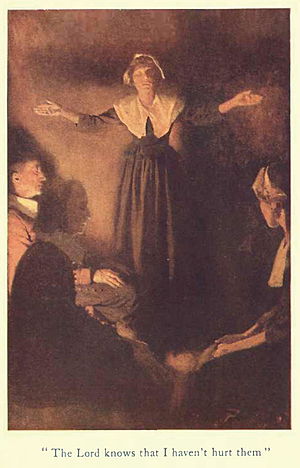
Rebecca’s trial began on 30 June 1692. As was customary for people accused of witchcraft, she represented herself and had no lawyer. Witnesses testified in her support, while accusers claimed that she afflicted them. The court admitted spectral evidence. The jury initially found her not guilty, but the verdict was reconsidered after public pressure and further deliberation. A question concerning her statement that another accused woman, Deliverance Hobbs, was “of her company” became significant. Family accounts stated that Rebecca, who was hard of hearing, had meant that Hobbs was a fellow accused person. The jury ultimately convicted Rebecca Nurse, and she was sentenced to death.
Rebecca Nurse was executed at Salem on 19 July 1692. Family tradition holds that, after her execution and burial near the execution site, relatives secretly removed her body and buried it on the family homestead. Her exact burial place has not been confirmed. In 1885, her descendants erected a granite memorial at the family cemetery in Danvers.
In 1706, Ann Putnam Jr., one of the accusers, made a public church confession expressing remorse for her part in accusing Rebecca Nurse and her sisters. The Nurse family accepted her apology. In 1711, Rebecca’s children successfully petitioned for reversal of the legal attainder and received compensation for her wrongful death. In 1712, the Salem Town church rescinded the excommunication imposed on her.
The Nurse family retained the homestead for several generations. The property later passed to the Putnam family and, by 1909, was preserved by volunteers as a historic house museum. The Rebecca Nurse Homestead remains on part of the original farm property.
Historical context
Rebecca Nurse’s accusation occurred during the Salem witch trials of 1692, when residents of the Province of Massachusetts Bay brought witchcraft accusations against neighbors and relatives. Courts accepted spectral evidence, or testimony that an accused person’s spirit had caused harm. Nurse’s case drew unusual support because she was widely regarded as a respectable church member and neighbor, yet that support did not prevent her conviction and execution. The later reversal of her attainder and rescission of her church excommunication reflect the subsequent recognition that she had been wrongfully condemned.
Sources & research
@S60@
Original family tree maker notes, including citations [1] through [13].
Original family tree maker notes include unsupported markers for two trial details: “[citation needed].”