Barbara’s family
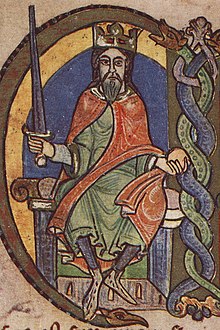
David I
Prince of the Cumbrians
31 DEC 1080 – 24 MAY 1153 · 23rd great-grandfatherDavid I, also called Dauíd mac Maíl Choluim, was Prince of the Cumbrians from 1113 to 1124 and King of Scotland from 1124 until his death on 24 May 1153. The supplied material describes his reign as a period of major governmental, religious, economic, and cultural change in Scotland.
Perhaps after 1100, David became a dependent at the court of King Henry I of England. There he was influenced by the court's Anglo-French culture. From 1113 until 1124, he held the position of Prince of the Cumbrians.
When his brother Alexander I died in 1124, David took the Kingdom of Scotland, or Alba, with the backing of Henry I. His claim was challenged by his nephew and rival, Máel Coluim mac Alaxandair. The resulting warfare appears to have lasted about ten years and included the destruction of Óengus, Mormaer of Moray. David's victory enabled the expansion of royal control into more distant regions that were theoretically part of his kingdom.
After the death of Henry I, David supported the claim of Henry's daughter, Empress Matilda, who was also David's niece, to the English throne. This brought him into conflict with King Stephen. Although David was defeated at the Battle of the Standard in 1138, he was able to expand his power in northern England.
Scholars use the term “Davidian Revolution” to summarize changes in Scotland during David's reign. These changes included the foundation of burghs and regional markets, the implementation of ideals associated with Gregorian Reform, the foundation of monasteries, the Normanisation of Scottish government, and the introduction of feudalism through immigrant French and Anglo-French knights.
David died on 24 May 1153. The supplied notes state that David I is recognized as a saint of the Catholic Church and that his feast day is celebrated on 24 May.
Historical context
David ruled during the 12th century, when Scotland's rulers were strengthening royal authority and developing new forms of government, trade, religious organization, and landholding. The changes associated with his reign are commonly described by scholars as the “Davidian Revolution.” His involvement in the dispute over the English throne also linked Scottish affairs to the wider conflict between Empress Matilda and King Stephen.
Sources & research
Original Family Tree Maker notes: “David I or Dauíd mac Maíl Choluim (Modern: Daibhidh I mac [Mhaoil] Chaluim;[1] c. 1084 - 24 May 1153) ...”
Citation [1]: Identified in the supplied notes only as the source for the modern form of David's name; no full citation was provided.
Citations [2] and [3]: Identified in the supplied notes only in connection with the statement that David I is a saint of the Catholic Church and that his feast day is 24 May; no full citations were provided.