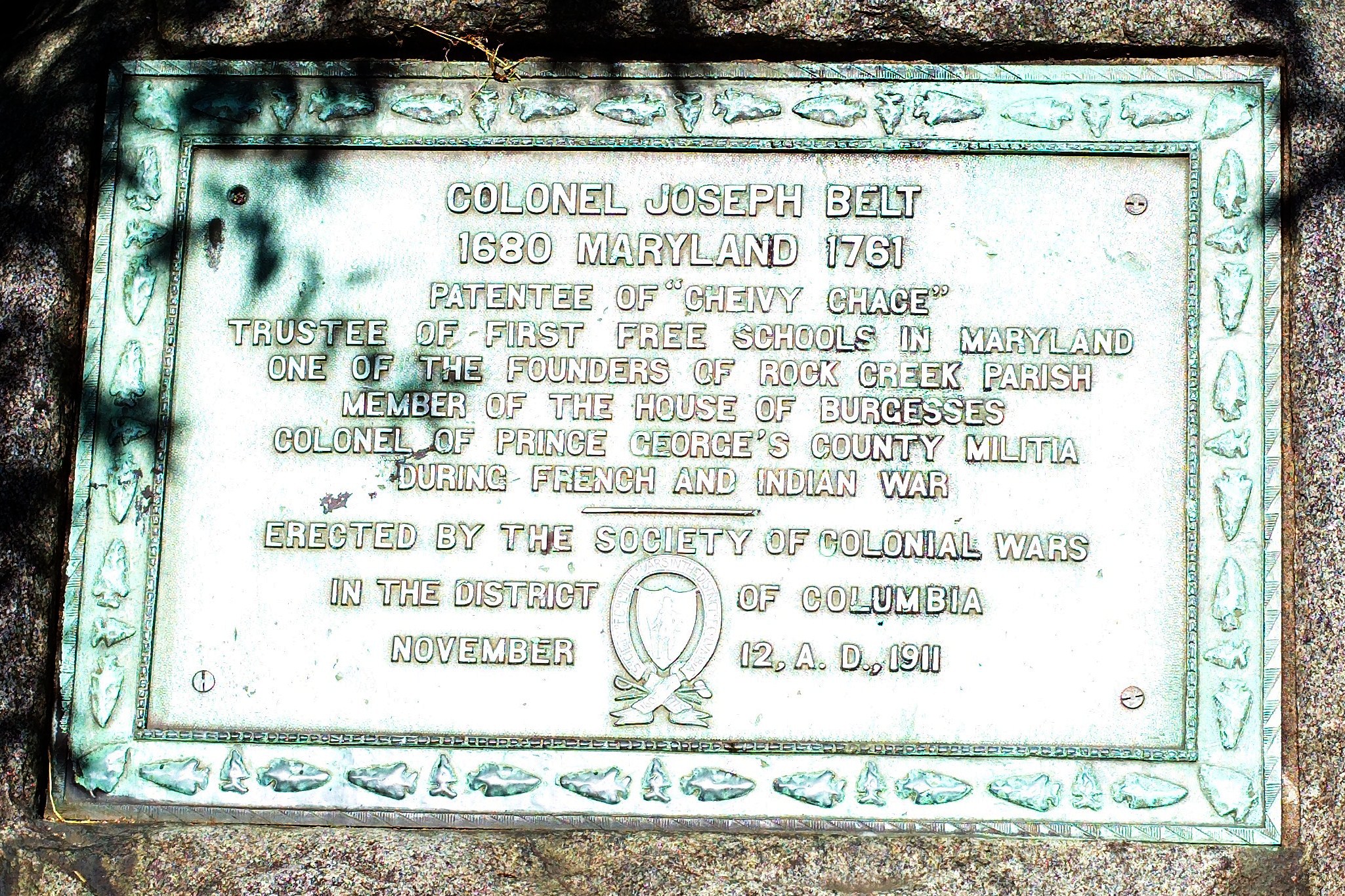
Joseph Belt "Chevy Chase Owner-Colonel"
Chevy Chase Owner-Colonel
ABT 1680 – 26 JUN 1761 ·Joseph Belt, often styled Colonel Joseph Belt, was a Prince George’s County, Maryland, landowner, public official, and militia officer. Born about 1680 in Anne Arundel County, he died at Chelsea in Prince George’s County in June 1761. He was associated with the Chevy Chase tract and manor, which later became part of the area near Washington, D.C.
On 12 April 1701, his mother, Elizabeth Belt, widow of Anne Arundel County, conveyed to him property described as his inheritance from his father. The conveyance included the tract called Good Luck, then known as the Widow’s Purchase, consisting of 200 acres in the forks of the Patuxent River on the north side of Beaver Dam Branch. He also inherited an interest in Friend’s Choice in Anne Arundel County.
Joseph settled in Queen Anne’s Parish in northern Prince George’s County. He married first Hester, also called Esther, Beall, daughter of Col. Ninian Beall and Ruth Moore Beall. The supplied family-history material states that he married secondly in 1727 Margery, widow of Thomas Sprigg Jr. and daughter of Capt. John Wight. It specifically cautions that Margery was not a daughter of Ninian and Ruth Beall, despite accounts that have identified her as a sister of Joseph’s first wife.
Belt acquired extensive landholdings through inheritance, grants, and purchases. The reported holdings included Friend’s Choice, Belt’s Discovery, Good Luck, Belt’s Hunting Quarter, Addition to Good Luck, Oronoka, Seneca Hills, Friendship, Arthur’s Seat, Thompson’s Lot, Belt’s Pasture, and Chelsea.
He is particularly associated with the tract called Chevy Chase, also spelled Chevie Chase and Cheve Chase in the supplied material. One account says that he patented 550 acres called Chevie Chase on 12 January 1721 and later enlarged it to 1,000 acres. Another account dates the patent to 1725. The tract was described as lying north of what is now Washington, D.C., in an area later associated with the District of Columbia and Montgomery County, Maryland. Family material states that the name was derived from the Cheviot Hills on the England-Scotland border.
About 1725, Belt built the Chevy Chase manor house. It was described as a brick, two-and-one-half-story house with a hip roof, located about 400 yards southeast of what is now Chevy Chase Circle. The house stood until 1907, when it was razed for improvements.
Belt held several public and military positions in Prince George’s County. He was a justice of the peace, described in the family-history report as a Gentleman Justice, in the 1720s. He served as a Prince George’s County delegate in the Lower House of the General Assembly or House of Burgesses; the supplied accounts differ on the exact span, giving 1725–1737, 1725–1736, and 1727–1729. He was styled lieutenant colonel in 1725 and colonel in 1728, and another account identifies him as colonel commanding the Prince George militia from 1754 to 1756. The family-history report notes that he was evidently a commissioned Provincial Militia officer but states that it is not believed he was actively engaged in a military campaign.
In 1723, he was named a Prince George’s County commissioner for the encouragement of learning and the erection of schools. In 1726 he was identified as one of the founders of Rock Creek Parish. On 27 March 1733, as a delegate from Prince George’s County, he presented a bill for laying out a town called Marlboro Town. The material also reports that in 1744 he was among those entrusted with the keeping and maintenance of a lot for a meeting-house used by the dissenting congregation at Upper Marlboro, and that he was made a visitor of the town’s free school. In 1748 he was a member of Col. George Beall’s Troop of Horse.
On 4 October 1738, Joseph Belt Sr. of Prince George’s County conveyed Friend’s Choice, near the Patuxent River in Anne Arundel County, to Nicholas Watkins, planter. The deed traced the tract through earlier owners and stated that it had been conveyed to Joseph’s father, John Belt, and left to Joseph by will. Margery Belt waived her dower rights in the conveyance.
Joseph Belt made his will on 14 June 1761. He died at Chelsea, Prince George’s County, in June 1761; the supplied material gives both 26 June and 28 June as his death date. His will was proved in Prince George’s County on 14 September 1761 by J. Sprigg, Joseph Ray, and John Perry.
His will gave his widow, Margery, a life interest in one-half of the dwelling plantation called Chelsea, along with several enslaved people, with the property thereafter to go to his son Humphrey Belt and Humphrey’s heirs. The other half of Chelsea went to his son Joseph Belt. His will also made provisions for his children, grandchildren, and daughter-in-law Anne Belt, including devises of Good Luck, Addition to Good Luck, Belt’s Discovery, Arthur’s Seat, Chevy Chase, Friendship, Thompson’s Lot, Seneca Hills, and a water mill on a branch called Collington near Marlborough. Humphrey Belt was named executor with Edward Sprigg.
Margery Belt survived him and died in 1783, according to the supplied report. Her will, dated 29 June 1772, was proved in Prince George’s County on 27 September 1783.
Historical context
Joseph Belt lived in colonial Maryland, where substantial landholders could hold county offices, represent their counties in the provincial assembly, serve in the militia, and act in local education and parish affairs. His Chevy Chase tract and manor later stood in the developing area north of the national capital. The supplied family history also records that Belt’s will included enslaved people among the property distributed to family members, reflecting the legal and economic system of the period.
Sources & research
Original Family Tree Maker notes, supplied by user.
Harry W. Newman, family history report prepared in 1949, portion copied in the supplied material; copy reportedly contributed by Mrs. Beverly Watts of Willows, California.
The Beall and Bell Families, by Colonel Fielder Montgomery Magruder Beall, Charles H. Potter & Co., Inc., Washington, D.C., 1929/1930, pages 48–50 and 90.
Maryland Historical Magazine, 1913, folio 198.
Archives of Maryland, Vol. 34, page 741; includes Joseph Belt’s will.
Newman source 1: Prince George’s Deeds, Liber C, folio 186, Hall of Records, Annapolis, Maryland.
Newman source 2: Parish Register, Maryland Historical Society, Baltimore.
Newman source 3: Anne Arundel Deeds, Liber RD No. 3, folio 94, Hall of Records, Annapolis, Maryland.
Newman source 4: Archives of Maryland, Vols. 35, 36, 37, and 39, numerous pages.
Newman source 5: Prince George’s Deeds, 1720, Liber J, folio 59.
Newman source 6: Archives of Maryland, Vol. 34, page 741.
Newman source 7: Archives of Maryland, Vol. 39, page 16.
Newman source 8: Archives of Maryland, Vol. 52, pages 634–635.
Newman source 9: Wills, Liber 1, folio 539, Marlborough Courthouse.
Newman source 10: Wills, Liber T, folio 176, Marlborough Courthouse.