Barbara’s family
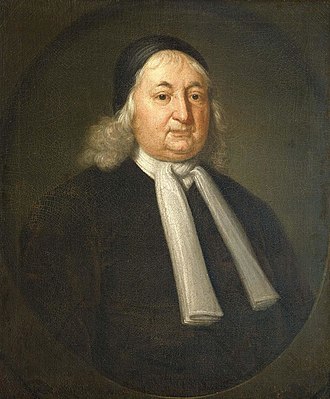
Samuel E. Sewall "Witch Trials-Mass.Cheif Justice"
Witch Trials-Mass.Cheif Justice
28 Mar 1652 - 01 Jan 1730 · 10th Great UncleSamuel E. Sewall (28 March 1652–1 January 1730) was a Massachusetts jurist, businessman, printer, and writer. He is especially remembered for serving in the Salem witchcraft proceedings, publicly acknowledging error afterward, publishing The Selling of Joseph in 1700, and serving as chief justice of the Massachusetts Superior Court of Judicature from 1718 until his retirement in 1728.
Sewall studied divinity and preached once before his marriage. On 28 February 1677, he married Hannah Hull, daughter and only child of John and Judith [Quincy) Hull. After his marriage, he left plans for the ministry and entered public life. His connection with the Hull family, including his father-in-law's work as treasurer and mint-master, was said to have influenced this change. He also managed a printing press in Boston for three years; another note dates this work to 1681–1684.
In 1684 Sewall was chosen an assistant and served for two years. In 1688 he traveled to England on business, remained abroad for a year, and visited several places of interest. In 1692 he became a member of the council and a judge of the probate court. That year he was also appointed among the commissioners to try witchcraft cases in Salem. During July and August, the court sentenced 19 people to death.
Sewall later publicly acknowledged his error in the witchcraft proceedings. On 14 January 1697, at Old South Church in Boston, the Rev. Samuel Willard read Sewall's confession of error and guilt before the congregation while Sewall stood in his place. The supplied account states that Sewall thereafter observed an annual day of fasting, meditation, and prayer in remembrance of the offense.
In 1699 Sewall became a commissioner for the English Society for the Propagation of the Gospel in New England and later served as its secretary and treasurer. In 1700 he published The Selling of Joseph, an essay described as an early appeal against slavery and as an argument for the rights of enslaved people. He later published The Accomplishment of Prophecies (1713), A Memorial Relating to the Kennebec Indians (1721), and A Description of the New Heaven (1727).
Sewall was named judge of probate for Suffolk County in 1715. In 1718 he became chief justice of the Massachusetts Superior Court of Judicature, the province's high court. He served until 1728, retiring because of increasing infirmities of age. He died in Boston, Massachusetts, on 1 January 1730.
Sewall kept a diary covering much of his life, a letter-book containing copies of important letters, and a commonplace book of quotations from his reading. At his death, he had also filled twelve manuscript volumes with abstracts of sermons and addresses he had heard. The Massachusetts Historical Society published his diary in its Historical Collections and also published his letter-book. His funeral sermon was preached by the Rev. Thomas Prince.
Historical context
Sewall lived and worked in the Province of Massachusetts Bay, where civic, judicial, religious, and commercial responsibilities often overlapped. His public role in the Salem witchcraft proceedings and his later public confession became central to accounts of his life. His 1700 essay The Selling of Joseph is described in the supplied material as one of the earliest appeals in the antislavery cause. His long service on the province's highest court placed him among the leading judicial figures of his time.
Sources & research
Original Family Tree Maker notes supplied for this profile.
Biographical account headed “SEWALL, Samuel, jurist.”
Massachusetts Historical Society, Historical Collections, identified in the supplied material as publishing Sewall's diary.
Massachusetts Historical Society, identified in the supplied material as publishing Sewall's letter-book.
The Selling of Joseph (1700).
The Accomplishment of Prophecies (1713).
A Memorial Relating to the Kennebec Indians (1721).
A Description of the New Heaven (1727).
Funeral sermon by the Rev. Thomas Prince.
Unidentified bracketed citations in the supplied note: [1] and [2].