Barbara’s family
III Malcolm "King of Scots"
King of Scots
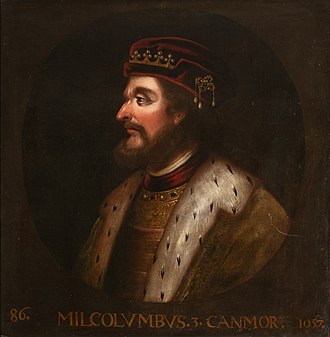
26 MAR 1031 – 13 NOV 1093 · 24th great-grandfatherMalcolm III, also called Malcolm Canmore in the supplied notes, was King of Scots from 1058 until his death on 13 November 1093. The notes describe his reign as a period of conflict with Norse rulers and with England, and as the beginning of the House of Dunkeld’s long rule in Scotland.
Malcolm III, King of Scots, was born on 26 March 1031. The supplied family-tree notes identify him as Malcolm Canmore, explaining the name as Gaelic for “big head.” They also describe him as a figure sometimes called the founding father of modern Scotland, while cautioning that this description overstates his role. According to the notes, his more lasting achievement was establishing a line associated with the House of Dunkeld, which ruled Scotland for the next 250 years.
The notes state that Malcolm’s father, Duncan I, was killed by Macbeth. Malcolm, then young, reportedly sought safety elsewhere, probably at the court of Siward of Northumberland, to whom his mother was said to be related. He later returned to contest Macbeth’s rule. In 1057, according to the notes, Malcolm defeated and killed Macbeth at the Battle of Lumphanan in Aberdeenshire. Macbeth’s stepson, Lulach, briefly succeeded him, but was also killed by Malcolm in 1058. Malcolm then became King of Scots.
During Malcolm’s reign, England was conquered by the Normans following the Battle of Hastings. The notes state that Malcolm gave sanctuary to Anglo-Saxon exiles after their defeat and that Anglo-Saxon attitudes and influences may subsequently have been adopted at his court.
Malcolm married twice. His first wife was Ingibjörg, widow of Thorfinn Sigurdsson, Earl of Orkney. The notes state that this marriage helped secure peace with Norse rulers in Scotland’s northern territories. Their children were Duncan, also called Donnchad; Donald, also called Domnall; and Malcolm, also called Máel Coluim.
After Ingibjörg’s death, Malcolm married Margaret, described in the notes as a direct descendant of the displaced Anglo-Saxon royal family. The notes observe a change in the names given to children of this marriage, away from the Norse or Gaelic naming tradition associated with his earlier family. The children named in the notes are Edward, Edmund, David, and Alexander.
Malcolm made numerous incursions into northern England during his reign. In 1072, the notes state that William I of England marched north and compelled Malcolm to agree to the Treaty of Abernethy. In return for swearing allegiance to William, Malcolm was reportedly to receive estates in Cumbria. The peace was uneasy.
In 1093, Malcolm again invaded northern England. The notes state that a planned meeting with William Rufus, the new King of England, to resolve a dispute concerning Cumbrian territories did not take place. Malcolm then returned with an army and devastated Northumberland. While returning to Scotland, he was attacked by the Earl of Northumbria and was killed at the Battle of Alnwick on 13 November 1093.
The notes state that Malcolm’s father, Duncan I, was killed by Macbeth. Malcolm, then young, reportedly sought safety elsewhere, probably at the court of Siward of Northumberland, to whom his mother was said to be related. He later returned to contest Macbeth’s rule. In 1057, according to the notes, Malcolm defeated and killed Macbeth at the Battle of Lumphanan in Aberdeenshire. Macbeth’s stepson, Lulach, briefly succeeded him, but was also killed by Malcolm in 1058. Malcolm then became King of Scots.
During Malcolm’s reign, England was conquered by the Normans following the Battle of Hastings. The notes state that Malcolm gave sanctuary to Anglo-Saxon exiles after their defeat and that Anglo-Saxon attitudes and influences may subsequently have been adopted at his court.
Malcolm married twice. His first wife was Ingibjörg, widow of Thorfinn Sigurdsson, Earl of Orkney. The notes state that this marriage helped secure peace with Norse rulers in Scotland’s northern territories. Their children were Duncan, also called Donnchad; Donald, also called Domnall; and Malcolm, also called Máel Coluim.
After Ingibjörg’s death, Malcolm married Margaret, described in the notes as a direct descendant of the displaced Anglo-Saxon royal family. The notes observe a change in the names given to children of this marriage, away from the Norse or Gaelic naming tradition associated with his earlier family. The children named in the notes are Edward, Edmund, David, and Alexander.
Malcolm made numerous incursions into northern England during his reign. In 1072, the notes state that William I of England marched north and compelled Malcolm to agree to the Treaty of Abernethy. In return for swearing allegiance to William, Malcolm was reportedly to receive estates in Cumbria. The peace was uneasy.
In 1093, Malcolm again invaded northern England. The notes state that a planned meeting with William Rufus, the new King of England, to resolve a dispute concerning Cumbrian territories did not take place. Malcolm then returned with an army and devastated Northumberland. While returning to Scotland, he was attacked by the Earl of Northumbria and was killed at the Battle of Alnwick on 13 November 1093.
Historical context
Malcolm’s reign, as presented in the supplied notes, took place during major political change in Britain. Norman conquest transformed England after the Battle of Hastings, while Malcolm’s Scottish kingship involved relations with Anglo-Saxon exiles, Norse interests in northern Scotland, and repeated disputes with English rulers over northern English and Cumbrian territories.