David’s family
Henry II King of England
King of England
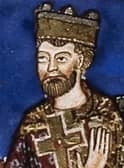
05 Mar 1133 - 06 Jul 1189 · 21st Great GrandfatherHenry II (5 March 1133 – 6 July 1189) was King of England from 1154 until his death and the first king of the House of Plantagenet. Known also as Henry Curtmantle, Henry FitzEmpress, and Henry Plantagenet, he inherited and acquired extensive lands in England and France and was the 21st great-grandfather in this family tree.
In 1150, King Louis VII of France made Henry Duke of Normandy. When Geoffrey V died in 1151, Henry became Count of Anjou and Maine. In 1152 he married Eleanor of Aquitaine, whose marriage to Louis VII had recently been annulled. Through this marriage Henry became Duke of Aquitaine. He became Count of Nantes by treaty in 1158.
Following Henry's military expedition to England in 1153, Stephen agreed to a peace treaty. Henry inherited the kingdom when Stephen died in 1154 and ruled as King of England until 1189. He was the first king of the House of Plantagenet. During the early years of his reign, he restored royal administration in England, re-established hegemony over Wales, and gained full control of his lands in Anjou, Maine, and Touraine.
Before he was 40, Henry controlled England, large parts of Wales, the eastern half of Ireland, and the western half of France, a territory later called the Angevin Empire. At various times he also partially controlled Scotland and the Duchy of Brittany. His desire to reform the relationship between the Crown and the Church brought him into conflict with his former friend Thomas Becket, Archbishop of Canterbury. The controversy continued through much of the 1160s and ended with Becket's murder in 1170.
Henry also came into prolonged conflict with Louis VII of France. Their rivalry, described in the supplied notes as a “cold war,” concerned territories in France. Henry expanded his holdings at Louis's expense, taking Brittany and moving east into central France and south toward Toulouse. Despite peace conferences and treaties, no lasting settlement was reached.
Henry and Eleanor had eight children: five sons and three daughters. Three of their sons would become kings. Their son Henry, known as the Young King, was named his father's co-ruler rather than an independent king. As the sons grew older, disputes over the future inheritance of Henry's lands increased. In 1173, the Young King rebelled against his father, joined by his brothers Richard, later king, and Geoffrey, as well as by their mother Eleanor. France, Scotland, Brittany, Flanders, and Boulogne allied with the rebels. Henry defeated the Great Revolt through military action and the work of local commanders, including men appointed for loyalty and administrative ability.
The Young King and Geoffrey rebelled again in 1183, and the Young King died during that revolt. The Norman invasion of Ireland provided lands for Henry's youngest son, John, later king, but Henry continued to face difficulty in satisfying his sons' demands for land and immediate power. By 1189, both the Young King and Geoffrey had died. King Philip II of France encouraged Richard's fears that Henry intended to make John king, leading to a final rebellion. Defeated by Philip and Richard and suffering from a bleeding ulcer, Henry withdrew to Chinon Castle in Anjou. He died there soon afterward on 6 July 1189 and was succeeded by Richard.
Henry's empire declined rapidly during the reign of John, who succeeded Richard in 1199. Nevertheless, changes made during Henry's long rule had enduring effects. His legal changes are generally considered to have helped lay the basis for English Common Law, while his interventions in Brittany, Wales, and Scotland influenced the development of their societies and systems of government.
Assessments of Henry's reign have varied. Contemporary writers Gerald of Wales and William of Newburgh, though at times unfavorable, praised his accomplishments, calling him respectively “our Alexander of the West” and an “excellent and beneficent prince.” In the 18th century, scholars portrayed him as an important force in creating an English monarchy and, ultimately, a unified Britain. David Hume called him “the greatest prince of his time for wisdom, virtue, and abilities, and the most powerful in extent of dominion of all those who had ever filled the throne of England.” Victorian-era historians were interested in the growth of Henry's empire but also concerned with his private life and his treatment of Becket. Later 20th-century historians combined British and French accounts to challenge earlier English-centered interpretations. Henry has remained of interest to academic and popular historians; Winston Churchill described him as a great king and the first great English lawgiver whose reign deeply affected English institutions.
Historical context
Henry II ruled during a period in which the English crown held extensive territories on both sides of the English Channel. His accession followed the struggle between his mother Matilda and Stephen of Blois for the English throne. The territories under his control were later described as the Angevin Empire, although they included England as well as lands in France and influence in Wales, Ireland, Scotland, and Brittany. His reign was marked by disputes with the French monarchy, conflict between royal and church authority, and family rebellions over inheritance. The supplied notes identify his legal reforms as an important foundation for English Common Law.
Sources & research
Original Family Tree Maker Notes for Henry II King of England, supplied in this request. No separate bibliographic citations were provided.
Gerald of Wales, quoted in the supplied notes as describing Henry as “our Alexander of the West.”
William of Newburgh, quoted in the supplied notes as describing Henry as an “excellent and beneficent prince.”
David Hume, quoted in the supplied notes concerning Henry's wisdom, virtue, abilities, and extent of dominion.
Winston Churchill, quoted in the supplied notes as describing Henry as a great king and the first great English lawgiver.